

Challenge, Perseverance, Feedback...Resiliency
The Ranger Assessment and Selection Program: A Case Study in Mental Toughness

Lots of talk these days about Resiliency; we used to call it Mental Toughness.
It’s all real. The data is overwhelming. We have a problem.
The question is…what can we do about it?
The Ranger Assessment and Selection Program (RASP) presents a useful resiliency microcosm for examination and understanding. RASP is our “canary in the coal mine,” illuminating different levels of collective resiliency over time – and more importantly – demonstrating how different training modalities are proven to increase our emotional fortitude and mental toughness.
The 75th Ranger Regiment is our Nation’s premier crises response force. The Rangers are ‘specially selected’ and ‘well-trained.’ Standards and expectations are high. Their mission is critical to our nation’s defense.
The Ranger Assessment and Selection Program (RASP) is the gateway into the Ranger Regiment. Every Ranger must pass RASP, a rigorous eight-week program that is both physically and mentally challenging. RASP ensures that newly assigned Rangers are prepared to serve in the Regiment and serves as the decisive moment of acculturation and on-boarding. It’s really tough.
RASP’s graduation rate has historically hovered at 50%; sometimes a little higher, sometimes a little lower. The 50% graduation rate, over time, predictably provides the required number of people for the Regiment to on-board.
Here is where things get spicy.
Starting in 2015, the RASP graduation rate started to drop, precipitously. By 2017, the graduation rate had dropped to an average of 27%, with some classes as low as 10%.
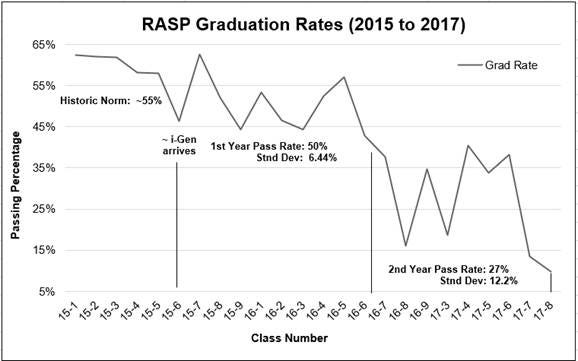
As the RASP graduation rates dropped, so did the manning densities of the Ranger Battalions. In 2018 the 3rd Ranger Battalion was manned at 72%. I was the Commander, it was a huge deal.
Something bad was happening, and we had no idea what it was. Throughout 2017 and 2018 we did all the things you might expect. We investigated and examined. We looked at the cadre, the standards, the program of instruction, the test grading, etc. Everything.
At first glance, it appeared as though the RASP Candidates were failing physical tests at abnormally high rates. Most of the failures occurred on the day of a fitness test, or 5-mile run assessment, or 12-mile road march. Our natural conclusion was that the RASP candidates lacked the physical fortitude to complete the course.
Turns out, that wasn’t the problem.
When RASP graduation rates dropped to the historic 10% low in 2017, the number one reason for a candidate failure was quitting. In March 2017 – candidates who quit the RASP accounted for 77% of all course failures. The following year, nearly 55% of all course failures had simply quit.
Most interestingly, the RASP Candidates would quit on the day of the physical assessment… before taking the test.
Let me say that again. The Candidates were quitting…before the hard tests.
The problem wasn’t physical, it was mental.
RASP hadn’t gotten harder, nor had candidates gotten physically weaker, they were simply not demonstrating the mental fortitude (toughness and resilience) required to endure the stress of the course.
So, the question becomes…how did we increase the mental resiliency of our RASP Candidates to enable them to pass the course without lowering our standards or expectations?
How did we make our RASP Candidates tougher and more resilient?
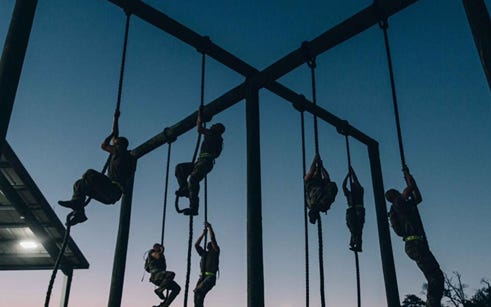
First, we made RASP harder. Yep, harder.
Let me explain.
The greatest degree of attrition normally happened at “Cole Range”, an intense and physically arduous training exercise in the backwoods of Fort Benning. It’s miserable. “Cole Range” had historically been conducted during the second week – sort of an introductory “hell week” experience. This is where we were losing most of our candidates.
We moved “Cole Range” to Week 7 of the program – and added a series of physical challenges in the preceding weeks. We added an obstacle course, a few extra days of land navigation, an extra two ruck marches, and a squad competition. In short, we increased the number of stress inoculating experiences so that by time the candidates arrived at Cole Range, they had a higher level of self-efficacy and were more likely to attempt (and succeed) in each day’s assessment. We had increased their experience and exposure to perseverance in the face of adversity.
Second, we started to actively coach the RASP Candidates. Let me explain.
As a result of program reforms that occurred in 2009, the RASP instructors were relatively dispassionate with the candidates. They provided no feedback, no criticism, no affirmation, no indication of success or failure. The dispassionate, unemotional, feedback free approach to leadership was extraordinarily stressful on the candidates. It was far more stressful than relatively caustic cadre approach that defined the pre-2009 version of RASP.
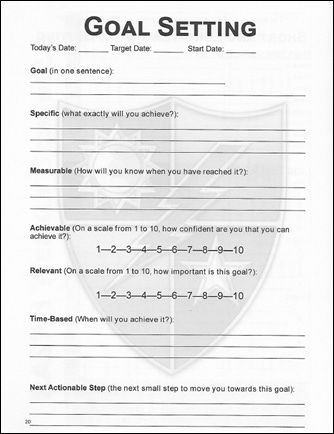
In 2018, the RASP Cadre started to actively coach the RASP Candidates. Each Candidate received a workbook that described the program of instruction, clearly delineated the standards, and provided a series of prompts to empower the Candidates to demonstrate ownership and agency in their progress. And, we enabled the Cadre to provide honest and candid feedback on their performance.
Third. We looked at our Cadre selection process. Turns out…On-Boarding and Integration is super important. The people that we charge with the acculturation of new teammates should exemplify the very best of our organization.
Our RASP Cadre were very good. But, truth in lending, we didn’t have a deliberate screening, selection, or assignment process for the Cadre themselves. Starting in 2019, the Ranger Regimental Command Sergeant Major implemented a series of reforms and oversight mechanisms to ensure that our Cadre were the very best from across the Regiment. Not the “very best available,” not “the very best that wanted the assignment,” not the “very best who were already stationed at Fort Benning,” but the VERY BEST. It was a nuanced but incredibly meaningful difference – and impact was impressive.
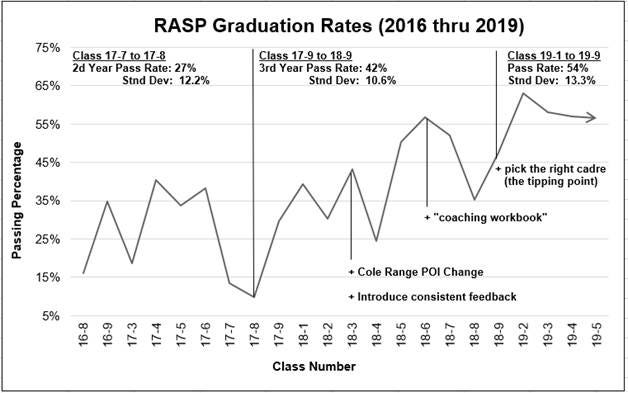
As a result (we think) of these three reforms, the RASP graduation rate increased through 2018 and 2019 until it reached the previous historic norms of ~50%. And, most importantly, we were able to reach those required benchmarks without lowering the standards or expectations of the Rangers.
The question, of course, is “So what?”
Well, it’s about building better, tougher, more resilient humans. For me, the lessons are universal and apply from parenting to leadership.
Keep things Hard and Make them Harder. Provide more opportunities for growth. Provide more challenges that are increasingly demanding. Iteratively inoculate participants against feelings of self-doubt and lack of confidence. Take the training wheels and bubble wrap off. Self-efficacy comes from the confidence that we gain from persevering through challenges. It takes practice, do it more.
Coach. Great leaders focus on ownership, empowerment, and enabling long term growth. They understand that personalized development and investment have the greatest potential for long term growth and organizational effect. People like to know the expectation, they want agency in their own goal setting, and they want honest feedback.
Pick the Right Cadre. Sir John Whitmore observes in Coaching for Performance, newly integrating subordinates will always look to their immediate leader for “acceptance and guidance” – working to emulate their “tone and example.” In short, we simply can’t put enough effort into selecting that team that leads and manages our acculturation and onboarding.
A few disclaimers.
First, I’m dated. This data is five years old. Second, this wasn’t my project or program. RASP is led by the Ranger Special Troops Battalion, which was Commanded by BG Joe Ewers. I had 3rd Ranger Battalion at the time and watched must of this conversation from across the street – literally. Third, hindsight is 20/20. While this essay makes it seem like there was a deliberate plan or strategy, that wasn’t the case. There was just a lot of good work being done by great NCOs and officers to solve the problem. The graduation data is real and accurate (provided by RASP leadership for some research I did in 2020), but the relationship between the different initiatives and the improved graduation rates is my own theory. The RASP Cadre definitely did those things. And the graduation rates definitely improved. But causality…anybody’s guess.
Exceptional positions Mike.
Thank you for your service--- in every way.
Your articulatiom is multifaceted and potent, an authentic gift and exhibition of human potential at its evolutionary best...
As a humble specialist in literature and linguist (Spanish and Persian),I never imagined I would be so drawn to reading such brilliant and inspiring essays on military topics. Congratulations and thanks to the United States Army for its excellent leadership, which gives our nation hope for the future.