

"No Excuse, Sir."
The Secret Sauce to Building a Culture of Accountability, Transparency, and Trust

“No Excuse, Sir.”
A simple phrase. It’s the first, and I argue, the most important thing a New Cadet learns at West Point.
Three words - the cornerstone for our profession. They are the foundation of the immutable trust of the American People. The words are simple. And they represent an incredibly powerful idea – we bear an unlimited liability (responsibility) for our organizations and our People. I’ve also heard the term “extreme ownership” – it’s the same thing – and it’s not a new idea.
That first day at West Point is a blur of mistakes and missteps – at least it was for me. The transition from citizen to Soldier is a bumpy road – filled with noise, confusion, and discomfort. Very early on that first morning, maybe within the first ten minutes, you learn a simple, timeless phrase that captures an immensely powerful idea. “No Excuse.” It’s a codified part of our developmental experience, captured on page 2 of our New Cadet Handbook. It’s been right there at the bottom since at least 1993.
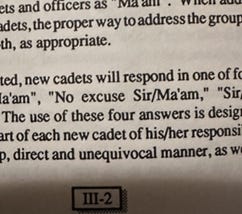
“No Excuse” is synonymous with, “I take full ownership, responsibility, and accountability for my actions.” For many young people, it’s a new idea. Heck, it’s probably a new idea for many old people too (but that’s probably a different essay).
Imagine this. A young kid breaks mom’s precious lamp.
“Henry, what happened?”
“Mom, I’m really sorry. I broke the lamp. It’s my fault. I’ll pay for it. It won’t happen again.”
Absolute fiction. What we’d actually hear would be…
“I don’t know mom. I think Sally broke it.”
The simple phrase “No Excuse, Sir” become a critical curricular bridge for our Cadets between yesterday’s children and tomorrow’s leaders.
Leaders must be willing to assume individual responsibility for themselves and their organizations. It’s a cultural and institutional imperative. The idea was first, or best, captured by S.L.A. Marshal’s 1950 Armed Forces Officer in which he describes the exceptional and unremitting responsibility of the profession. Indeed, the 2017 version of this same professional publication references professional responsibility 87 times. 87.
The Ranger Handbook, published by the Department of the Army, makes the expectations of young officers equally clear. Different words, same idea…

In both daily practice and execution, the assumption of responsibility for our missteps, large and small, remains a cultural and professional cornerstone of our Army.
This morning, literally an hour ago, I adjudicated the punishment for two Cadets who violated our Academy regulations. They broke the rules. To be completely honest, their transgression was pretty minor, and at a normal college or university wouldn’t have drawn any attention at all. But we’re different. As we worked through the administration of their punishment, our conversation centered firmly on their ability to take responsibility for their actions and to demonstrate a propensity to learn from their mistakes. Growth mindset.
I’m reminded of the first time I ran a machine gun qualification range as a young officer. I completely messed it up. I didn’t look in the book to understand the standards, I didn’t count the number of Troopers to train, I didn’t take inventory of the ammunition available. Nothing. Nope. We just started shooting. By the time I realized that I had made a mess of things, it was too late. We were beyond the point of no-return, we didn’t have enough time or ammunition (resources) to correct my mistake. When we got back to the headquarters I reported to my Commander, CPT Fox, to inform him that I was singularly responsible for messing up our training plan. He then went and had the same conversation with his boss. Nobody was happy.
I’m reminded of the first time one of my Soldiers was killed in combat. I was standing on the flight line at the airbase in Kandahar as the evacuation plane, the Hero Flight, took off for Germany. To say that I was upset would be the understatement of the century. I remember looking at my Commander and blurting out, “Sir, I feel completely responsible.”
He answered, “No Shit.”
It was a perfectly honest (and incredulous) response. Of course, he went on to mentor and coach me about the burden of Command in combat and the weight of responsibility and all of those things – but there was absolutely no doubt in the conversation – leaders must be, and feel, and take responsibility. The lesson stuck. I would Command in combat four more times.
Here is where things get interesting. Cultural values – like responsibility, accountability, and trust – can’t just be words. They can’t just exist in the soft spaces of human interactions. They must be captured, embedded, and reinforced into our organizational processes and structures. About five years ago I learned about (and took notes on) a socio-technical model that explains how organizations (and cultures) work.
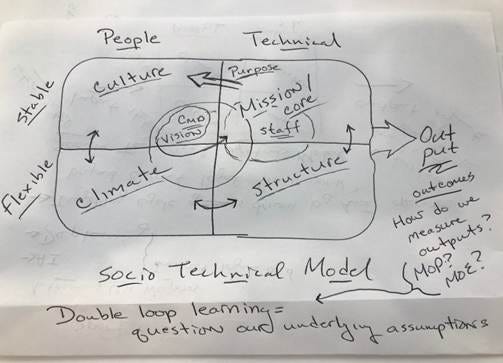
A culture of transparent accountability must be reenforced by organization’s structural systems. Organizational processes actively shape and reinforce culture by embedding values, assumptions, and power relationships into everyday routines and actions.
Our processes define what matters, what gets measured, and what gets punished or rewarded. Processes are both a manifestation and an embedding mechanism to our values and culture.
For example, our Army’s investigative and disciplinary processes directly reinforce and affirm values like trust, transparency, and accountability.
When a Soldier, officer, or leader is accused of wrongdoing – the Army investigates it. We have no shortage of investigative entities and no shortage of different types of investigations. Military Police, the Criminal Investigation Division, the Inspector General, Property Loss Officers, Equal Opportunity, etc. etc.
A personal story. About seven years ago, in an unsavory attempt at professional sabotage, an anonymous colleague alleged that I had been arrested and charged for breaking a state law. To be clear, everything about this allegation is categorically false. And the fact that the allegation against me was filed a few days before a very competitive Command selection board only adds intrigue to the drama. The whole thing was absurd. I’ve never been arrested, not even close; I think I have two traffic tickets, maybe three 😉.
But, because we maintain the People’s trust through institutional accountability, my Commander was obligated to investigate the allegations. The Army appointed an Investigating Officer. He checked six different law enforcement databases, collected statements and searched for evidence. It was an exhaustive effort. He wrote a five-page report which categorically cleared me all allegations.
Though I was never guilty, the conduct of the investigation was important for several reasons.
First. It was about the Profession and our relationship with the American People. The Army, like any profession with unique expertise, must be self-regulating. “Self-regulation” is manifested through the integration of routine oversight processes. Think about the internal oversight mechanisms within the medical, legal, or accounting professions. All adherent to professional standards – all self-regulating. Within the Army, professional self-regulation includes allegations against leadership. Perhaps “self-regulation” is most important when it includes allegations against leaders. The investigation wasn’t about really about me…it was about the fidelity of the profession and maintaining the long-term trust of the American people. It was about “No Excuse, Sir” at an institutional level.
Second. This investigation, and our investigative processes writ large, are about maintaining trust within the ranks, with our Soldiers. There can be no double standards. Leading by Example is important. We must have the right processes to ensure that our leaders are in fact setting the right example.
Third. The investigation brought closure. Unbiased and impartial, the General Officer who investigated me scoured for evidence and testimony and then weighed what he found (nothing) against requirements of Federal and State Law as well as Army Regulations. Without the closure from the investigation, the allegation may have swirled as malicious rumor in perpetuity.
No Excuse, Sir.
Of course, there might be a completely different way of thinking about responsibility and accountability. Maybe it’s about not only being responsible for when things go wrong, maybe it’s about the intrinsic responsibility to shape our own future – to make sure thing go right.
Why not run a 5k race next month?
No Excuse.
Why not work up to a marathon?
No Excuse.
Why not apply for a new and better job?
No Excuse.
Why not write a book, hike the Pacific Crest Trail, or take one of life’s small risks?
No Excuse.
There are two final and additional points worth noting.
First. Yes, today’s Cadets actually learn the phrases “No Excuse, Sir.” “No Excuse, Ma’am” and “No Excuse, Sergeant.” Things change - but not much.
Second. There is an entire other perspective on the Army’s bureaucratic investigative processes. Trust me, I know, I was a Battalion and Brigade Commander for six years. There is a good debate to be had on how to achieve the right level of transparency and due process – but that’s an article for another day. And, I’ll argue until the end of time, that the values that underpin our process are good, and noble, and ultimately reinforce a culture of trust and accountability.
Third. I know, some of you are wondering whatever happened to the person that made the false allegation against me. Well, nothing. In order to preserve the long-term trust in our whistle blowing systems, and to prevent leader retribution and reprisal, that person is protected. Appropriately so - because it protects our long run fidelity and trust in the profession. Personally, I don’t let it bother me. Life’s too short. And No Excuses.
An amazing article…again! I truly admire your dedication to personal honesty. The sound regulations that the Army operates under and the honor that the officers, soldiers and cadets are expected to adhere to are very admirable!
My Dad would be proud to see that the Army /country he served is still a tight run, well oiled machine!
It makes me proud to know how the US Army holds to is requirements and faithfulness to a job well organized and executed. I also feel safer knowing they protect our country.
Thank you for being a dedicated and honest, honorable commander who accepts no excuses. The United States Army is a better defense system because men and women dedicated like you to its purpose will never make excuses!
THANK YOU FOR YOUR SERVICE . MAY GOD BLESS YOU AND ALL THOSE SERVING TO KEEP ME AND THE REST OF THIS COUNTRY SAFE AND FREE. I DO NOT TAKE IT LIGHTLY! ❤️🙏🇺🇸