

Irrefutable Proof - Running Makes You Younger!
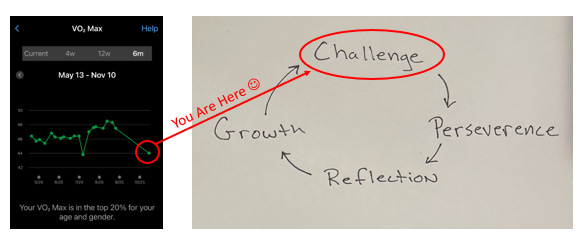
A Story of Challenge, Perseverance, and More Challenge

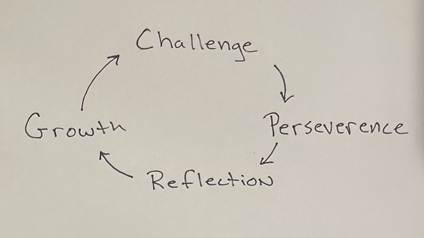
I’m a true believer. We become better people in moments of challenge and discomfort. This isn’t my idea, and it isn’t a new idea, but I’m completely bought in.
As we settle into a world of modern convenience and comfort, it’s important that we continue to seek out those moments of challenge and perseverance.
And, for truth growth and learning to occur, we should be pretty intentional in self-reflection. Again, not my idea and not a new idea. In some venues we would call this an “After Action Review” or a “Post Mission Debrief.” Whatever we call it, it’s a critical step in getting better.
About three months ago I ran a 50-mile ultra marathon at Philmont Scout Ranch in New Mexico. This wasn’t the biggest deal in the world or the hardest thing I’ve done. But nobody would call me an ultra-runner. I’m 51 years old; I weight 225 lbs., and I have plenty of aches and pains.
This was simply a personal challenge.
These are my lessons…with pretty interesting data to back them up.
The story starts on September 16th of last year. After years of pain and discomfort, I finally relented and got a much needed tune up on left shoulder. Surgery was great. But, six weeks in a sling and another six weeks with limited resistance training was horrendous. It was like watching 35 years of athletic activity slip away. Early in the recovery I vowed to accomplish two goals within 12 months. The first was to run 50 miles. The second was to complete a CrossFit “Cindy” workout with my new shoulder (also complete).
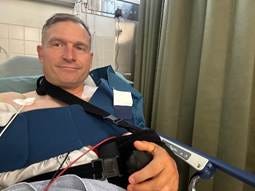
In any event, I was relatively sedentary from September to December. We bought a good exercise bike, and we walked and hiked a lot, but it wasn’t enough. I gained 15 lbs. and lost almost all of my aerobic capacity and upper body musculature.
November 21st. First run; 10 intervals, 1 minute each, at an 11:48 pace…slightly faster than a brisk walk. It was a dose of humble pie, but it was something.

On January 31st we decided to commit to the Philmont 50 Mile Ultra-Marathon. It seemed like a reasonable goal to achieve in 7 months. We started keeping track of milage, recovery, and calories.
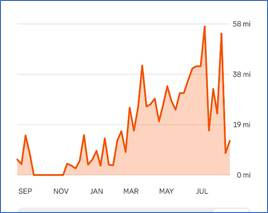
Here is what I learned.
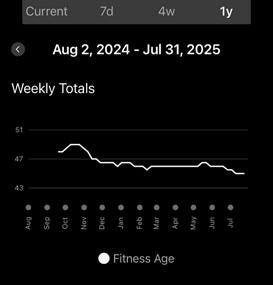
First Lesson. Running makes you younger. Sort of. Garmin wearable devices have a neat little feature in which they calculate your “Fitness Age.” Garmin’s Fitness Age is a combination of your VO2 max, resting heart rate, activity level, variable heart rate, and body fat percentage – all relative to age group norms in the United States.
In October…my Garmin Fitness Age was 49 years; perfectly average for my age…which isn’t great considering the state of adult health and wellness in the United States.
In November, with just a moderate amount of physical activity my Fitness Age was 47 years; a remarkable improvement with only a little bit of work.
By July, just before the race, my Garmin Fitness Age was 45 years…which is the top 10% of my age group.
There are a few obvious lessons:
- A moderate amount of exercise makes a huge and measurable difference.
- Consistency matters.
Second Lesson. VO2 Max improves, measurably, as a function of running volume.
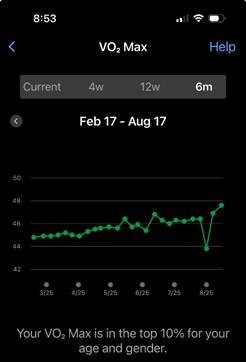
In January, my VO2 Max was 44 mL of oxygen per kg of body weight per minute (ML/kg/min).
By March, my VO2 Max was 45 mL/kg/min.
By June, my VO2 Max was 47 mL/kg/min.
In late August, it was 48 mL/kg/min.
If you are young…aerobic capacity is about crushing the fitness testing (or maybe looking good at the beach 😉). If you are old…aerobic capacity is a protective factor against killers like heart disease and diabetes. Young or old…aerobic capacity is important.
There is no surprise that consistent aerobic exercise, mostly running in Zone 2, increases your aerobic capacity (VO2 Max).
But there are two really interesting points tucked into the data.
- First, during the race (August 2nd) my VO2 Max was measured at 44 mL/kg/min…a significant regression. I think this was a function of altitude; the race started at 6,700 feet and capped out at 11,750 feet. Said differently, the reduction in my VO2 Max likely illustrates the lower oxygen availability at Philmont’s higher elevation.
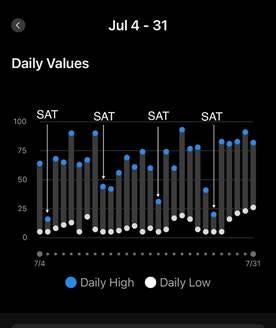
- Two, the degrading effects of alcohol can’t be overstated. To be clear, I am extraordinarily responsible and moderate with alcohol. Like, an exciting Friday night for the Kloeppers is a glass or two of wine while watching TV. But, apparently even that minimal alcohol consumption makes a huge difference. It’s bad.
Garmin has a measurement called Body Battery – which is basically a combination of your sleep quality, sleep quantity, and heart rate variability. One or two glasses of wine on a Friday night ruins our sleep quality and thus impacts our training readiness (Body Battery) on Saturday – even if you can’t physically or physiologically feel it. I can’t help but to wonder how many long Saturday morning runs over the last 30 years were basically a waste of time.
And so, the story ends where it began…with a challenge. This past September I pulled a hamstring. In mid-October I fractured my foot. My VO2 Max has plummeted right back down to 44 mL/kg/min.
I’m back on the bike – focusing on upper body strengthening.
No problem, this is what life is about. I fully intent to run the Philmont 50 miler again next summer. It’s not really about the race; it’s about the challenge and journey to get there. It starts today.
Your articles are always meaningful! You are a trooper in more ways than one! Praying for your complete recovery! 🙏🇺🇸
Beautifully and detailed explanation of how movement is essential in our daily lives. I would dare to bring my own and personal interpretation on this subject. It is said that the human body consists of three-fourths of its capacity in water. Now, if water does not move and becomes stagnant — stagnant water, in Persian, is called “dead water.” When water dies, it begins to stink. Therefore, one must move constantly to show signs of life. Life is movement, constant change.
In Persian, âb-e râked (آب راکد) means “stagnant water.” Water that doesn’t flow becomes corrupt — it loses its purity, it “dies.” Flowing water, like a river or a spring, renews itself, stays clean, vibrates with life.
In the same way, the human being — whose body is mostly water — must move, change, and transform. Movement, not only physical but also emotional and spiritual, is what keeps life fresh and meaningful.
Thank you for sharing your experience with us and happy Veterans Day to all.