

Building Diverse and High Performing Teams
30 Years of Lessons Learned from Leading and Serving with Our Nation's Best

People. Our Most Precious Resource.
One of the things I love most about the Army is the people. In ways that are impossible to describe, the Army is a perfect reflection of our Nation’s total tapestry. There are so many different kinds of people, from so many different places and backgrounds, all working toward the same mission. In some ways, it’s really pretty utopian.
Case in point. I grew up in Caldwell, New Jersey…a relatively affluent, conservative, and racially homogeneous commuter suburb in Northern New Jersey. Northern New Jersey isn’t really known as a hotbed for military recruiting. 99% of people that I’ve had the honor and privilege to serve with over the last 30 years…not from North Jersey.
Until recently, I had never really given much thought to diversity. It’s not that I’m not well informed or paying attention to contemporary topics. Rather, it’s just not a thing that I spend a lot of time ruminating on. In my experience, there isn’t really much to think about, we just build our teams…and do the job.
But…it seems like there is so much emotion, anger and misunderstanding about the role of diversity in team building…mostly by folks without a lot of practical experience…it might be worth exploring a little bit. After all, if we’re going to get better…we shouldn’t be afraid to have hard conversations.
Diversity
Let’s start by defining the term diversity. In today’s discourse, diverse classifications among humans have become synonymous with racial, ethic, and gender-based differences…we call these salient physical differences. But there are obviously lots of other and different ways in which people can be different from each other. Values, beliefs, traditions, background, familial upbringing, income level, educational background, religious affiliation, interests, professional experiences, age…the list differentiating human characteristics goes on and on.
We should frame the question. Afterall, if we don’t ask the right question, we’ll never figure out the right answer. For the purposes of this discussion, the question is something like, “What is the impact of a team’s diversity on its effectiveness and its ability to accomplish the mission.”
- Some will say that diverse teams are inherently more effective.
- Some will say that diverse teams are inherently less effective.
- Some will say that the composition of the team makes no difference at all.
None of those are entirely true, and none of those are entirely false. Let me explain.
Team Building
Broadly speaking, newly formed diverse teams generally outperform homogeneous teams when the task is cognitive (requires problem solving, innovation, adaptation, or decision making in an uncertain environment.) This makes perfect sense; an increased number of perspectives, backgrounds and experiences better equip newly formed teams to understand and solve novel and complex problems. So, if you are in a classroom, or workgroup, or planning team…diversity is a strength.
Equally true…newly formed homogenous teams generally outperform diverse teams when the task is easily understood, straightforward, and execution focused. This also makes perfect sense. In the absence of any additional experience or information, humans will default to perceptions of similarity…which are frequently based on physical differences that are easy to see. This is called the similarity-attraction paradigm. So, if you are doing a simple set of straight forward and easily understood tasks…like maybe a team obstacle course…homogeneity is a strength.
Here’s the thing though… all teams, especially in the Army, need to perform a myriad of tasks…both cognitive and tactile (hands on). There are no one-trick ponies. And, all teams (diverse and homogenous), are subject to the team formation dynamics that happen over a period of time.
Here is where things get interesting.
How Do Teams Actually Form?
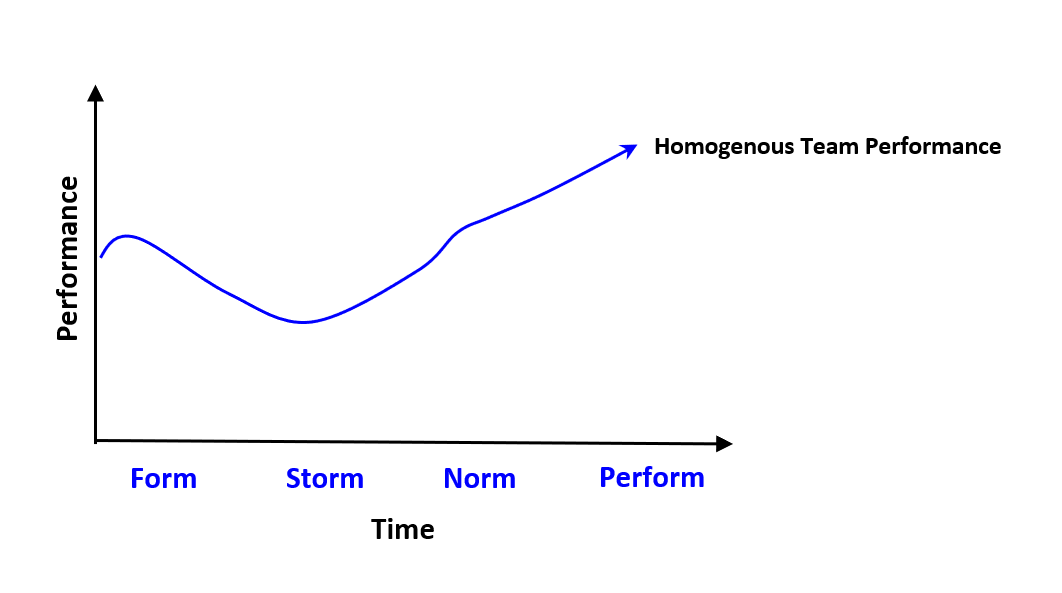
There is a pretty well studied and commonly understood model that describes team formation called Tuckman’s Model of Group Development (Bruce Tuckman, 1965). Tuckman described that teams go through four distinct phases…
Forming. New members are polite and seek direction.
Storming. Differences emerge; team members test each other’s boundaries.
Norming. Members establish hierarchy, credibility, and trust. Collaboration improves.
Performing. The Team operates effectively towards a common purpose & goal.
Tuckman goes on to describe, with a credible body of research to back him up, teams generally outperform individuals. Graphically, Tuckman’s model, especially for homogenous teams, would look something like…
Tuckman’s Model might look a little different when applied to a diverse team…
Diverse teams may experience the polite Forming Phase of group development differently because they have a lower sense of immediate familiarity.
Diverse teams experience the Storming Phase of group development differently, because they may experience the friction of unfamiliar values, unfamiliar contexts, and unfamiliar personal boundaries.
And…diverse teams will ultimately outperform their homogeneous counterparts once cohere during the Norming Phase and start to Perform to their potential.
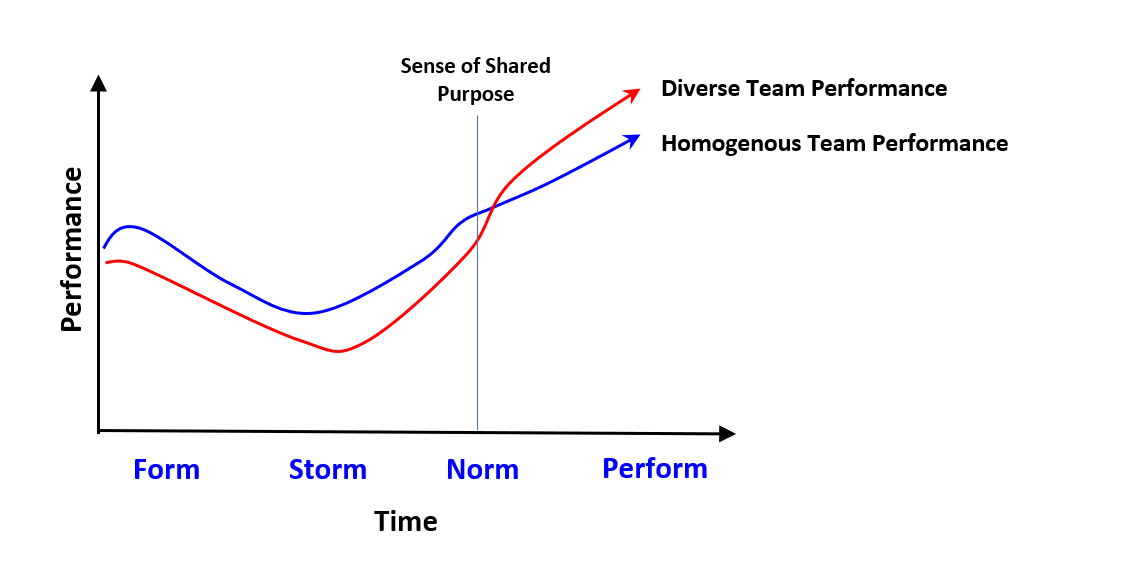
To understand why diverse teams are likely to outperform homogenous teams in the long run, the variables of team cohesion – and to understand how team cohesion occurs during the Norming Phase.
But What About Cohesion…
There are two basic forms of team cohesion – Social Cohesion and Task Cohesion.
Social Cohesion is the degree to which members enjoy working together based on social commonalities. If you’ve missed the connection…think back to similarity attraction paradigm. Social Cohesion is good, but it’s also relatively weak. Remember that question about who you sat with at lunch on your first day at Middle School? Chances are you…you don’t remember. And, chances are, you didn’t sit there for very long.
Task Cohesion is the degree to which members are united by purpose; committed to accomplishing their shared mission and goal. Task cohesion is incredibly strong; for a Soldier…it’s everything. Task cohesion is why a Soldier from Kansas will give his life for a Soldier from Chicago…though they may have little in common…other than shared values and a shared commitment to the mission. When senior leaders say, “Our strength is our shared purpose,” that’s perfectly true.
Pulling It All Together.
Leadership. Referring back to the diagram of Tuckman’s model, there is a moment during the Norming Phase of group development in which team members gain a sense of shared purpose. More specifically, there is a moment during the Norming Phase in which leaders inspire a sense of shared purpose, members are transformed into a trusting and cohesive team. Cohesive teams live for each other…and will sacrifice for each other.
Values. When it comes to building cohesive teams….and creating a sense of shared commitment…alignment of values between team members becomes decisive. I’m not suggesting that everybody must agree with each other or have the same opinions; rather I am suggesting that the power emerges from shared values. For example, treating people with respect is an indicator of values alignment…not necessarily opinionated agreement. (Note…this is why so many great organizations are so very clear about their organizational and cultural values. It’s about alignment).
Standards. When it comes to building a team…all members absolutely must have the required professional credentials for the job. Everybody has to meet the standard. Every Army Ranger has to pass a 12-mile physical assessment; every lawyer has to pass their state bar exam; every Certified Public Accountant has to pass the CPA Exam. Standards are about professional and institutional trust; there are no two ways about it.
Conclusion. Clearly, this is a wildly complex topic; far more than most pundits would have you believe. So, to squeeze emotion and bias out of the discussion, I’ll attempt to present this out as logically as I can….
Diverse Teams are generally better at cognitive tasks.
Homogenous Teams are generally initially better at activity-based tasks.
All Teams (Diverse and Homogenous) transform when leaders inspire shared purpose.
Therefore…
In the long run…when faced with a myriad of complex requirements…in an uncertain environment…diverse teams that are well lead, united by purpose, and grounded in standards will achieve the best results. Period.
In Closing...
We end at the beginning. One of the things I love most about the Army is the people. For 30 years I’ve served with young people from all-corners of our Nation…from the Ivy Leagues to the heartland, from Chicago to Columbus and everywhere in between. They are a National Treasure. None of them were from Caldwell, New Jersey. Very few of them are like me, but brothers and sisters, united by Leadership, Values and Purpose.
I get a lot of misplaced “credit” for building a “diverse” team in the corporate world. I built the best team I could and that meant the right skills, filling the right gaps, or the best performance. Some people like to focus on the fact that means I have women in “non traditional” roles in a utility, or that I have “minorities” in a white male dominated industry. I just apply the lessons of our Army in the civilian world, and I think it could do with more of that in more places. Our Army is the best of America and there is no reason those lessons can’t translate to every industry. If veterans keep giving back by leading instead of listening to the voices that call us broken we can really make a positive difference.
Another informative and deftly crafted piece.
Perhaps the best compliment I can give each time I read (or listen) to one of your pieces is - I want to share this with my wanna be Soldier son. This piece is no exception…